Science-Based, Serving Science

🔬 Open Science & Digital Commons • Since 2012

Science is one of the foundational pillars of Open Food Facts. Since 2012, we have turned peer-reviewed nutritional and environmental research into accessible public tools, while providing the world's scientific community with an open digital commons to advance public health.

600+
Google Scholar Papers
Citing Open Food Facts
138+
Curated Studies
Indexed in our research showcase
100%
Open Data (ODbL)
Free, transparent & verifiable
100+
Research Teams
Institutes, labs & universities
Core Foundations

Our Three Scientific Pillars

How Open Food Facts connects academic rigor, crowdsourced data, and open science.

🥗

1. Science-Based Scoring

We do not invent proprietary scores. We strictly implement official, peer-reviewed public health metrics: Nutri-Score (EREN / Inserm), NOVA food processing classification (Prof. Carlos Monteiro, USP), and Eco-Score / Green-Score (ADEME Agribalyse), making complex science understandable in grocery store aisles.

🤖

2. Technology at Scientific Scale

Our open-source platform combines citizen crowdsourcing with optical character recognition (OCR), neural vision networks, and natural language processing to extract, structure, and validate nutritional declarations, ingredient lists, and additives on millions of products.

🌐

3. Returned to the Global Commons

All collected product data and computed indicators are redistributed under the Open Database License (ODbL). Researchers worldwide enjoy barrier-free, permanent access to high-fidelity food data without paywalls, commercial restrictions, or vendor lock-in.

Collaborative Research

Working Hand-in-Hand with Research Teams

Partnering with world-renowned epidemiological institutes, public health agencies, and academic labs.

Nutritional Epidemiology
Open Food Facts team meeting the EREN research team

Meeting the EREN Research Team

We met and collaborated with the EREN research team (Inserm / INRAE / CNAM / Université Sorbonne Paris Nord) led by Prof. Serge Hercberg and Dr. Chantal Julia, aligning data taxonomies and validating automated Nutri-Score calculation algorithms.

Academic Scan Parties
University of Liège Scan Party

Collaboration with Liège University

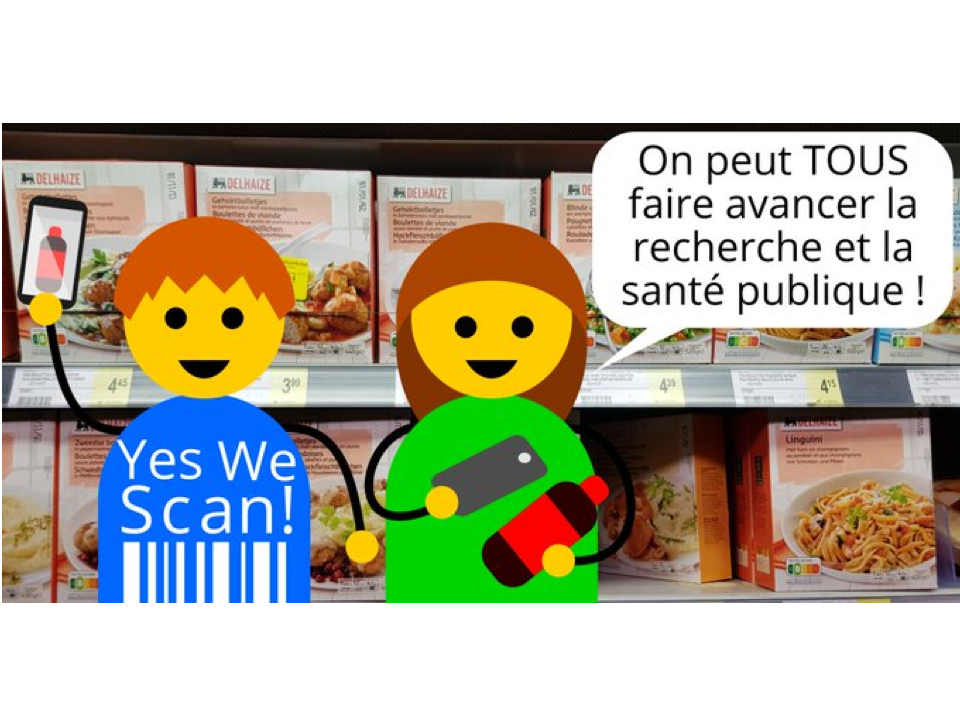
The clinical nutrition department at the University of Liège organized large-scale student Scan Parties in Belgian supermarkets, building a comprehensive national food dataset to support comparative nutrition benchmarks across Europe.

Citizen Science
Crowdsourcing and Citizen Science tools

Crowdsourcing for Research at Scale

Open Food Facts equips research teams with self-service tools, specialized mobile scanning modes, and barcode campaign dashboards, allowing academic labs to build representative food brand samples rapidly at near-zero expense.

Google Scholar
Articles citing Open Food Facts on Google Scholar

Peer-Reviewed Publications

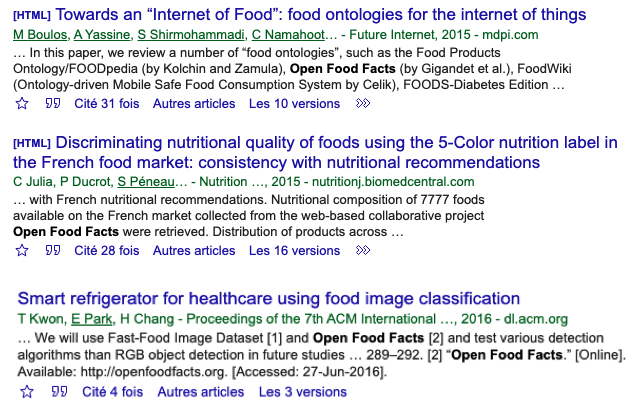
Open Food Facts data is actively cited and analyzed in hundreds of peer-reviewed journals, including The Lancet, BMJ, Nature Food, and Nutrients, spanning nutritional epidemiology, artificial intelligence, and environmental life cycle analysis.

"Given the major public health challenges linked to nutrition that we are facing today on a global scale, it is essential to promote the consumption of a diet that is more conducive to good health. In this context, a digital database containing information on the various health aspects of food (nutritional composition, degree of processing, additives, etc.) is an essential tool for public health research and action."
SH

Professor Serge Hercberg

Emeritus Professor of Nutrition, Université Sorbonne Paris Nord • Creator of the Nutri-Score

Transparency & Commons

How Open Data Accelerates Scientific Research

The Wikipedia of food: turning messy real-world packaging into structured research infrastructure.

📊

Standardized Food Taxonomies

Open Food Facts organizes multi-country packaging data with standardized taxonomies for food categories, ingredients, allergens, food additives (E-numbers), nutrient reference values, and recycling instructions across 150+ countries.

🧬

Interdisciplinary Exploration

Beyond clinical nutrition, our database powers breakthroughs in computer science (optical character recognition, multimodal vision-language models), behavioral economics (supermarket nudge studies), and food sustainability (greenhouse gas footprints).

🔄

Reproducibility & Open Science

Scientific credibility demands reproducibility. Because Open Food Facts archives historic snapshots and open calculation source code, researchers can replicate findings, benchmark algorithms, and publish open datasets without commercial secrecy.

Resources & Access

Researcher Toolkit & Data Access

Everything you need to incorporate Open Food Facts into your lab's next research project.

📦 Database Snapshots

Download daily database dumps in JSONL, CSV, MongoDB, and Parquet formats for big-data and statistical analyses in Python, R, or Julia.

Access Data Dumps ➔

🔌 REST API & SDKs

Query live product data with our free REST API and official client libraries for Python (openfoodfacts-python), R, Dart, and JavaScript.

Read API Docs ➔

🔬 Curated Publications

Browse 138+ academic articles categorized by research themes: Nutrition, NOVA & UPF, Additives, AI & Vision, and Environment.

Browse Publications ➔

📖 Science Wiki & FAQ

Explore our community science guide with best practices for handling missing nutrients, deduplication, and geographic filtering.

Visit Science Wiki ➔
Academic Citation

How to Cite Open Food Facts in Your Papers

Ensure proper attribution under the Open Database License (ODbL) by referencing the database snapshot date.

APA Style (7th Edition)
Open Food Facts. (2025). Open Food Facts Database [Data set]. Retrieved from https://world.openfoodfacts.org/data

BibTeX Format
@misc{openfoodfacts_database,
  author       = {{Open Food Facts}},
  title        = {Open Food Facts: A Free, Collaborative Global Food Database},
  year         = {2025},
  url          = {https://world.openfoodfacts.org/data},
  note         = {Open Database License (ODbL)}
}